Camp Caius
The RookCamp Caius is the secret Welsh compound behind an illegal second Estate: a covert training operation financed with money siphoned from the Checquy and designed to produce a private army of altered young people. Its existence reveals a hidden rival to the Checquy’s own training system, while its students and graduates make the consequences of that project concrete.
A covert second Estate
The discovery begins with financial records. Although the diverted sum was small relative to the Checquy’s overall budget, it had been enough to buy land in southern Wales, construct buildings, and establish a school for young people with extraordinary abilities—or, as Myfanwy’s investigation would show, young people selected for a very different reason. Camp Caius is described as a second Estate, a distinction that matters because the original Estate’s rigorous training of children is presented as a foundation of the Checquy’s power. A parallel institution under unauthorized control would therefore amount to an illegally held strategic force.
The compound was set apart from a nearby village by a steep-walled valley and a single access road passing through old woods. Villagers understood it as a secret military installation. Supply trucks crossed the village early in the morning but did not stop, and no one from the compound appeared to visit. Teenagers found a gap in the fence where it crossed a gully and used it to watch the grounds. They reported unusual lights and shapes in the sky and people moving across the lawns in unfamiliar ways; to Myfanwy, those strange sights suggested a place more recognizable than its official secrecy implied.
Camp Caius’s protection depended chiefly on being hidden and underfunded. Its guards used conspicuous vehicles that local teenagers said were easy to spot, and the fence lacked razor wire. Myfanwy judged these arrangements markedly weaker than those of the original Estate, where hiding in the woods would not have been enough to evade the guards and no village would have stood nearby. The contrast suggests that secrecy, rather than a fully developed security perimeter, was the compound’s principal defense.
Buildings and conditions
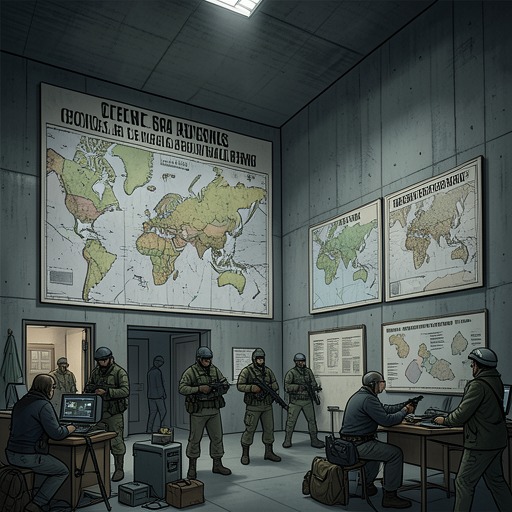
A map inside the compound identified four principal areas beyond Admin: Living Quarters, Instruction, Physical Plant, and a Medical building that was larger than the others. The map also marked cameras and alarm sensors with glowing indicators. Myfanwy did not have time to inspect every building, but the layout pointed to a school organized around students, instruction, and medical intervention, with its administrative records kept in locked offices.
The students’ living conditions contrasted sharply with those at the original Estate. The shower rooms had no partitions or cubicles, and cameras monitored the bathing areas. The dormitories held six beds in one room and eight in another, with no curtains around the beds and no storage furniture for the children’s clothes. Myfanwy regarded the rooms as prisonlike; her comparison with the more private arrangements at the Estate makes the deprivation visible without turning it into an abstract difference in institutional style. Even the basic accommodation denied the students privacy.
Finances, students, and medical practice
Records at Camp Caius went back twenty years. The account numbers Myfanwy had traced through the Checquy’s finances confirmed that the missing funds had reached the compound. A substantial share paid for training and surgical facilities; instructors earned more than staff at the original Estate, and the surgeons were paid more still. The spending did not produce comfortable surroundings. Instead, the contrast between bare dormitories and costly training and medical services suggests where the operation’s resources and priorities lay.
The school kept students until age twenty-three, after which graduates were sent to a place called Albion. The records Myfanwy found did not explain where Albion was or what happened there. Output was limited: Camp Caius had produced about fifteen graduates in five years, despite having fourteen students at the time of her investigation. She learned that many students died, some in training exercises and most during operations. That mortality helps explain why a long-running, well-funded institution had produced so few graduates, and makes its apparent investment in instruction inseparable from the risks of its medical program.
Myfanwy’s copies showed six girls and eight boys, aged eleven to twenty-two. They did not appear to have natural supernatural abilities; instead, the evidence suggested that surgery was used to give them capabilities. The children came from different parts of Britain and from families with varied social and economic backgrounds. Myfanwy investigated their families and health records but could find no common feature that explained why they had been taken. The absence of an apparent selection pattern left the purpose of choosing these particular children unresolved.
Discovery and exposure
Myfanwy entered Camp Caius after tracing the financial diversion and deciding that the secret operation required direct investigation. She found its name in office memoranda, then searched the filing cabinets for records of its funding and students. The documentation confirmed the destination of the money, but it did not identify any member of the Checquy Court as the person overseeing the project. Reports went to an unnamed Founder. The gap between the extensive administrative scheme and the absence of a named authority left the operation’s leadership concealed even as its institutional footprint became clear.
Her intrusion later became a vulnerability for the people running the compound. After a guard suffered a seizure, Camp Caius staff examined the incident because they feared that one of their subjects might have affected someone nearby. Testing revealed traces of Myfanwy’s power. A staff member recognized those traces using unofficially shared results from her earlier testing at the Estate. Conrad Grantchester said this discovery prompted him to move quickly against her: he kept Camp Caius graduates at the Apex in a discreet bodyguard role and brought a handpicked group to the Rookery using concealed entrances he knew about.
Grantchester’s own account connected the school to his conspiracy. He acknowledged personally overseeing the establishment of Camp Caius, the recruitment and indoctrination of agents inside the Checquy, and the development and placement of a fungal weapon. His stated intention for the weapon was mass subjugation across a large area once activated. Camp Caius was thus not an isolated school project but one component of a wider effort directed against the Checquy.
Graduates and aftermath
Graduates appear as armed protectors in the confrontation at the Apex. One is Norman, a scaled young man whose body and abilities were extensively modified at Camp Caius; Grantchester described a regime of repeated surgery, injected substances, and implanted systems, as well as his dependence on seven intravenous drips. Norman could interfere with a person’s brain through physical contact, initially affecting consciousness or the use of powers and, with closer contact, potentially affecting memory. His dependence on continuing medical support underscores how the school’s enhancements also made their subjects vulnerable.
The other young guard is a girl of about eleven with unusual abilities. In the encounter, she moved with exceptional speed and struck Myfanwy while Norman advanced under Grantchester’s orders. The scene establishes that the operation’s products were not only kept at Camp Caius: graduates could be deployed as a force protecting its leadership. It also sets a limit on what Myfanwy knew about the school’s outcomes, since she had feared Camp Caius graduates might be among Grantchester’s allies before seeing them in action.
After Grantchester’s defeat, the Barghests planned an assault on Camp Caius with orders to take as few lives as possible. Myfanwy was left confronting the question of what could be done for the children there. She intended to try to rehabilitate them, though she could not bring herself to feel pity for Norman and remained haunted by the memory of the dead girl with talons. That unresolved response refuses an easy division between victims and weapons: Camp Caius had made children into instruments of violence, while the damage and deaths associated with its methods could not be undone by exposing the institution.
Camp Caius’s significance lies in the way it mirrors and distorts the Estate. Both institutions train young people, but Camp Caius operates without lawful authority and uses surgical alteration to manufacture abilities; its austere rooms, extensive medical infrastructure, and high death toll reveal the cost concealed behind its promise of a private army. Its discovery exposes Grantchester’s reach inside the Checquy and leaves the organization with a further problem after his defeat: what to do with the children produced by the system he built.